
How Dental Implants Became the “Gold Standard” of Tooth Replacements
November 3, 2025
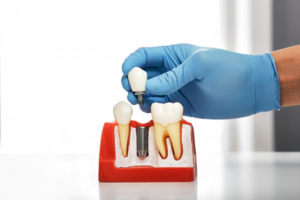
Before modern dental implants became available for widespread use in the 80’s, civilizations had some…interesting tooth replacement methods. Ancient Mayans carved seashells to be embedded in the gums, for example, while the Chinese experimented with bamboo pegs. Let’s just say that there’s a reason these materials aren’t used today!
Clearly, dental implants have come a long way to be known as the “gold standard” of tooth replacements. A brief overview of how they’ve improved over the years will really drive this point home!
A Strong Start: Titanium
Today, the dental implant posts that are responsible for anchoring your restoration to your jawbone are made from titanium. Scientists knew this special substance existed as early as 1791, but they didn’t know how to replicate it until 1910! Even then, it took several more years to develop a process for creating the metal on a mass scale. That accomplishment goes to William J. Kroll, who invented an efficient fabrication method in 1932.
Firm Foundations: Osseointegration
Osseointegration, the natural process where bone fuses with certain materials, was another crucial piece of the dental implant puzzle. Dr. Per-Ingvar Brånemark discovered this in the 1950’s after a medical device he left on a rabbit femur completely merged with the bone. Can you guess what the device was made out of? That’s right – titanium!
Previous attempts at dental implants failed because the materials would ultimately be rejected by the body. But Dr. Per-Ingvar Brånemark found that titanium is pure enough to be accepted without issue.
Polished Aesthetics: Tooth-Colored Materials
These two developments are all about the structural integrity of dental implants. Titanium and osseointegration are the main reasons why dental implant restorations last twice as long and are significantly more powerful than their traditional counterparts. But what about their seamless aesthetics? Did dental implant replacements always look so natural?
Not exactly. Tooth-colored dental materials were developed in the 1950’s – however, these early resin composites weren’t as polished as they are today. More durable and cosmetically appealing formulas wouldn’t be invented for another 20 years. Finally, in the 80’s, they were refined enough to receive widespread use for fillings, crowns, and, of course, dental implants.
Reaping the Benefits of The Past
It took centuries for dental implants to become what they are today. Peering into the past and seeing all the developments that had to be made can definitely give you a new appreciation for all of that hard work! Implant dentists now are just as mindful and meticulous when providing patients with their new teeth. Thanks to their dedication and modern technology, you can be confident when it’s time for your dental implant treatment.
About the Author
Dr. Thomas G. Peters diligently keeps his dental skills sharp and up-to-date through continuing education opportunities. In fact, he became a Master in the Academy of General Dentistry, something that only 2% of dentists in the US have achieved. The program requires a minimum of 1,100 hours in dental courses, including 400 hours of hands-on experience. As part of his efforts, Dr. Peters learned how to complete the entire dental implant process himself, meaning you won’t have to worry about a referral for oral surgery. To restore your smile with the “gold standard” of tooth replacements, contact Dr. Peters’ office at 860-677-8500.
No Comments
No comments yet.
RSS feed for comments on this post.
Sorry, the comment form is closed at this time.